

Good morning everyone,
I hope that you’re all having a great day 🙂
We use words like ‘fair’ and ‘fairness’ almost daily in our conversations, but do we really know what they mean? Is there a way to determine what is more or less fair than something else? Well, in today’s blog, we will be looking at British Philosopher John Broome’s theory of fairness, which made a significant contribution to, and is one of the most engaged theories in the fairness space!
Hello & Welcome to Sweeney’s Blogs!
Setting the Scene
John Broome’s theory of fairness states that claims to a good “should be satisfied in proportion to their strength.” This raises what Broome believes the business of fairness is, which is “to mediate between conflicting claims of different people” to a particular good, whether that good is divisible or indivisible.
Here, we need to specify what Broome is saying when he uses certain vocabulary. ‘Goods’ are objects (for instance a car, money, or a painting) or things that are beneficial to people. The difference between a divisible and an indivisible good is that a divisible one can be split or shared between different parties (such as money), whereas an indivisible good cannot be split. A ‘claim’ is the reason that a candidate has for wanting to receive the good. When Broome discusses the satisfaction of claims, this relates to the fair treatment of claims against each other.
A teleological reason is a reason for distributing a good that maximises its expected benefit (such as happiness or utility) to the candidate. The term teleological is used quite a bit in philosophy and is fairly similar to the word ‘telos’, which typically refers to the ultimate goal or aspiration of an action. Side constraints, however, are rights to a good that are completely inviolable.

In his theory, Broome defines claims as “duties owed” to a candidate, which can be generated through need, desert & other forms of duties relating to the distribution of a good. Broome does not classify teleological reasons or side constraints in his definition of a ‘claim’. Broome argues that equal claims to a good require an equal level of satisfaction, that stronger claims require greater satisfaction than weaker claims, and that weaker claims still do require some form of satisfaction. He states that “weaker claims must simply not be overridden by stronger ones.”
Broome’s Argument
Broomean fairness can be applied to the distribution of goods, regardless of their divisibility. Here’s an example of how Broome’s fairness would work out when it comes to a divisible good first:
Imagine we had 3 employees, called Chidi, Tahani & Eleanor, who were all promised a bonus based on the number of tables they served in a day. At the end of the day, Chidi had served 80 tables, Tahani had served 40 tables & Eleanor had served 20 tables.

For the employees, their manager owes a duty to each of them to settle their claims for bonuses. However, Broome’s theory of fairness only requires that the manager settles their claims in proportion to their strength. Whether they were paid £80, £40 & £20 respectively or £8, £4 £2 would be equally fair under Broome’s theory, as they would all be being paid in proportion to the strength of their claim.
John Broome’s theory of fairness is applied differently when it comes to indivisible goods, which we will see in the following example:
Suppose we had 2 candidates, named Jason & Janet, who have both been promised tickets to go & see their favourite band, Erasure, perform, however, there is only one ticket remaining.
Both parties have an equal claim to the good, so how do we get to decide who gets the ticket? Broome’s theory of fairness states that “equal claims require equal satisfaction”, which is what we need to consider here. As there is only one ticket remaining, and it cannot be divided, Broomean fairness would indicate that we would need to factor in some form of surrogate satisfaction.
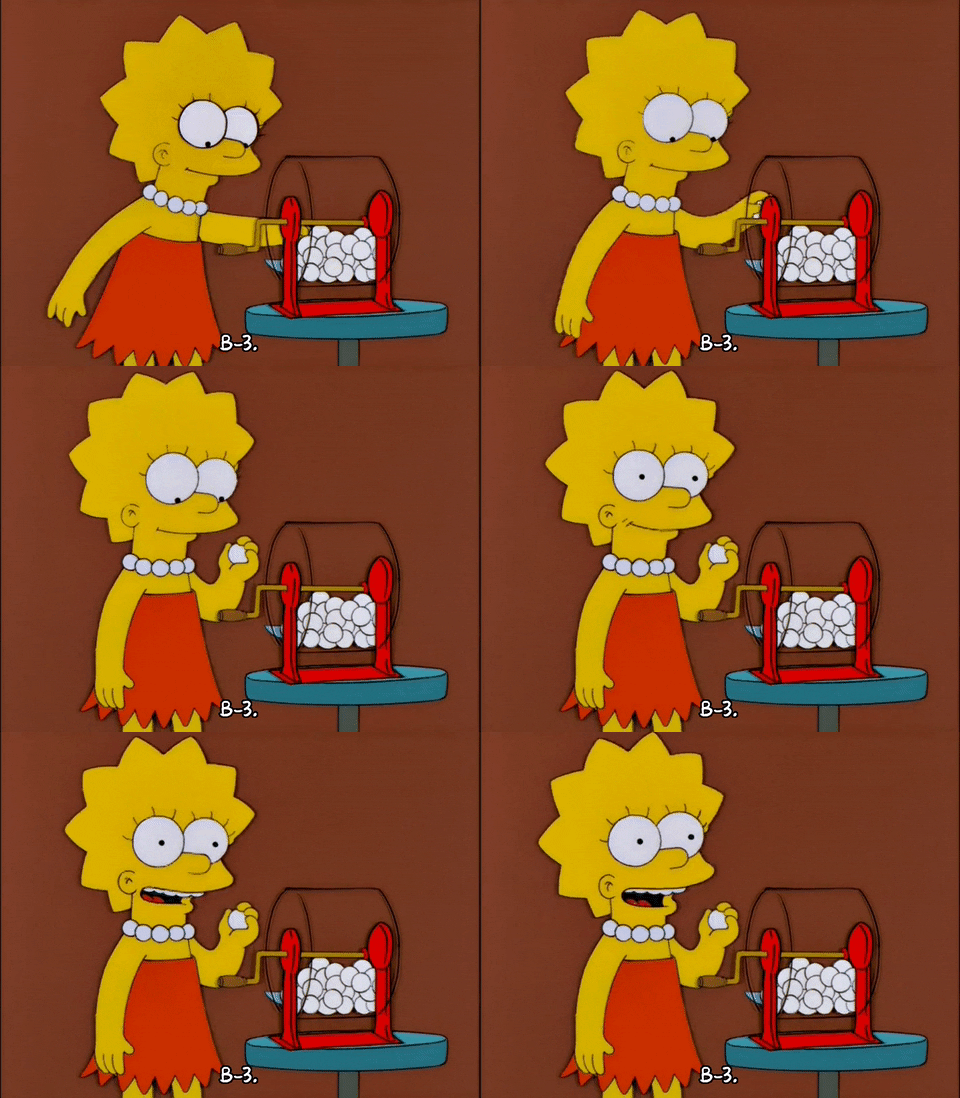
By holding a balanced lottery, each candidate “can be given an equal chance of getting the good”. This does not achieve perfect fairness, but it does adhere to Broome’s satisfaction & proportion requirements, which Broome believes is the fairest way to distribute the good.
What if Jason had a claim to the ticket that was twice as strong as Janet’s claim? How would that factor into Broome’s theory of fairness? Broome’s theory of fairness states that “stronger claims require more satisfaction than weaker ones”, however, weaker claims do still require some satisfaction.

It would be unfair to simply override Janet’s claim, on the grounds that Jason’s claim is stronger. To ensure that claims are satisfied in proportion to their strength, a weighted lottery should be held. As Jason’s claim is twice as strong, she would have 2 entries in the lottery, and Janet would have 1. The weighted lottery would ensure that both candidates have an opportunity to receive the good, weighted on the strength of their claim. Jason is twice as likely to be selected in the lottery, due to the strength of her claim being double Janet’s.
In Summary
John Broome’s theory of fairness states that claims to a good should be satisfied in proportion to its strength. He argues that equal strength claims require an equal level of satisfaction, that stronger claims require larger satisfaction than weaker claims, and that weaker claims do still require some satisfaction.

Broome states that the business of fairness is to “mediate between the conflicting claims of other people”, and he provides us with an option for how we can ‘fairly’ distribute a good, regardless of its divisibility. Although it has its critics & objections, John Broome’s theory of fairness plays a key role in and is one of the most discussed, papers in the fairness literature.
That’s all for today’s blog, what do you think? I know that this blog was a lot more academic and in-depth than the large majority of my other ones, but this is something that I’ve wanted to talk about on the page for a while now! Do you enjoy seeing posts on philosophy? Would you like to see more? Are there any blogs or topics that you would like to see me write about?
Be sure to let me know your thoughts & answers to the above questions, either in the comments below or through our Facebook page!
Thanks for reading & I hope you have a lovely day!

Sweeney’s Blogs
Any money donated here is greatly appreciated, and will be directly reinvested back into the page!
£5.00
James
References
Broome, John. 1990–1991. Fairness. Proceedings of the Aristotelian Society 91: 87–101.
 Sweeney's Blogs
One thought on “What is John Broome’s ‘Theory of Fairness’?”